Frequently Asked Questions – FAQ
Bright-Dtech™ technology
On what is Bright-DtechTM technology based?
Bright-DtechTM is based on lanthanides nanoparticles.
Lanthanides are chemical elements having the atomic number from Z from 57 (lanthanum) to 71 (lutetium). Their general electronic configuration is [Xe] 4fn5d16s2 where n is included between 0 to 14 and represents the number of electrons and [Xe] corresponds to the electronic configuration of the noble gas xenon. In aqueous solvents, lanthanide ions are under the state Ln3+ where they are the most stable in most cases. Each lanthanides elements have different optical and magnetic properties. Today, lanthanides are mainly used as catalysts or magnets. They are present in optical lasers, fibers, television, batteries for phones, computes or cars. In the last years, their specific properties have attracted life sciences and medical areas, especially for the detection of biomarkers.
The power of the nanoparticles resides in its nanometric structure. Nanoparticles are small objects between 1 to 100 nm and find applications in various sectors including healthcare, environment preservation, or cosmetic industry. Nanoparticles present offer many advantages such as their small size, large surface area for functionalization and good stability. They have many advantages, like small size, a large surface area for functionalization, and an excellent stability.
What are the advantages of Bright-DtechTM compared to other fluorophores?
This technology offers many advantages such as high brightness, long emission lifetime, large Stokes shift and photostability compared to other fluorophores whose performances are moderate.

Why using Bright-DtechTM ?
Based on lanthanides technology, Bright-DtechTM nanoparticles are 100-1000x brighter than Quantum dots, which allow a more accurate detection and reduce detection limits.
The high efficiency of the nanoparticles and their ease of use will enable them to replace current fluorescent molecules developed in the 2000s, which offer only moderate performance.
FLUORESCENT PROBE

BRIGHT-DTECH TECHNOLOGY

Why is Bright-DtechTM so bright?
With a large energy gap between the lowest excited state and the highest gournd level each lanthanide has a specific spectroscopic signature. The spectral range of lanthanides is large and they emit a strong luminescence:
-In the visible region (Sm3+, Eu3+, Tb3+, Dy3+)
-In the near infrared region (Nd3+, Er3+, Ho3+, Tm3+, Yb3+)

Bright-DtechTM ‘s brightness is based on 3 factors:
−Molar obsoprtion coefficient: Capacity of a molecule to absorb at a specific wavelength
−Quantum yield: Number of emitted photons per number of absorbed photons
−Brightness: With the luminescent quantum yield and the molar absorption coefficient, the brightness can be calculated by the following equation:

What is fluorescence lifetime?
When a luminescent compound is excited, the excited state is populated and the return to the ground state results in the emission of light. This de-excitation intensity decreases exponentially with time, following the law:

- I0 : Intensity after excitation
- Iem: Measured intensity at time t
- t : Time
- T : Excited-state lifetime
Lifetime is the time a fluorophore stays in its excited state. Conventional fluorescent nanomolecules have very short luminescent lifetimes. Lanthanide nanoparticles have an exceptionnally long lifetime, in the range of millisecond. Long lifetime presents many advantages: low background noise, high intensity of emission, high sensitivity, accurate measurement.
Are there any scientific publications based on the technology that we can refer to learn more?
Yes, the scientific publications and references are the following:
−Ultra-bright lanthanide nanoparticles
Terbium-doped LaF3 nanoparticles, surface-functionalized by photon-harvesting antenna ligands. Surface capping with antenna ligands leads to ultrabright nanoparticles, with the typical green luminescence signature of Tb atoms and very long excited-state lifetimes
Joan Goetz, Aline Nonat, Abdoulaye Diallo, Mohamadou Sy, Ildan Sera, Alexandre Lecointre, Christophe Lefevre, Chi Fai Chan, Ka-Leung Wong, Loïc J Charbonnière
Chempluschem. 2016 Jun;81(6):497.
doi: 10.1002/cplu.201600117
−Ultrabright Terbium Nanoparticles for FRET Biosensing and In Situ Imaging of Epidermal Growth Factor Receptors
Design of a ligand that can be simultaneously applied as an efficient light-harvesting antenna for Tb surface ions and a strong binder of biomolecules to LnNPs surfaces.
Cyrille Charpentier, Vjona Cifliku, Joan Goetz, Aline Nonat, Clémence Cheignon, Marcelina Cardoso Dos Santos, Laura Francés-Soriano, Ka-Leung Wong, Loïc J Charbonnière, Niko Hildebrandt
Chemistry. 2020 Nov 17;26(64):14602-14611.
doi: 10.1002/chem.202002007
−Live cell imaging without autofluorescence using terbium nanoparticles
Application of a new type of surface photosensitized terbium NPs (Tb-NPs) for autofluorescence-free intracellular imaging in live HeLa cells. Combination of exceptionally high brightness, high photostability, and long photoluminescence (PL) lifetimes for highly efficient suppression of short-lived autofluorescence, enabling timed PL imaging of intracellular vesicles over 72 h without toxicity and at extremely low concentrations of Tb-NP for up to 12h.
Joan Goetz, Marcelina Cardoso Dos Santos, Ka-Leung Wong, Loïc J Charbonnière, Niko Hildebrandt, Hortense Bertenlian
Bioconjugate Chem. 2018, 29, 4, 1327–1334.
doi: 10.1021/acs.bioconjchem.8b00069
Bright-Dtech™ Ready-to-use kits
Which couplings can we choose with Bright-DtechTM ?
Bright-DtechTM is available coupled to streptavidin, biotin and IgG antibodies such as Anti-Human IgG (H+L), Anti-Rabbit (H+L), Anti-Goat (H+L), Anti-Mouse (H+L).
How to couple Bright-DtechTM ?
The working solution must be prepared freshly before each utilization.
- Resuspend the Bright-DtechTM by mixing the tube well by sonicating at 4-15 °C (or vortex at room temperature) between 1min and 5min
- In a glass tube or in a low protein binding tube, dilute Bright-DtechTM in Dilution Buffer
- Bright-DtechTM is now ready to use
The use of Bright-DtechTM depends on the application. Contact us to know which dilution buffer you should use.
Recommended Consumables: To prepare antibodies free of amines and phosphates, other proteins and preservatives that can interfere with the conjugation process. At Poly-Dtech, we mainly use Zeba™ Spin Desalting Columns, 7K MWCO, 0.5 mL and Amicons from Merck.
For which applications can we use Bright-DtechTM?
Bright-DtechTM can be used in a wide range of applications:
- TR-FRET
- TR-FLISA
- Lateral Flow
- Multiplexing
Bright-DtechTM could be suitable for other applications such as:
- Western Blot
- In vitro applications
- Immunofluorescent for microscopic analysis
- Quantitative PCR
Can we use Bright-DtechTM for an ELISA test?
Yes, it is possible to use Bright-DtechTM in an ELISA test. In this case, the enzymatic revelation will be replaced by a fluorescence signal which can be read on a TRF compatible microplate reader.
Can we use Bright-DtechTM in an already started TR-FRET /TR-FLISA/Lateral Flow or multiplex test?
Yes. Bright-DtechTM can troubleshoot and even improve your detection issues encountered during protocol development.
Can we use Bright-DtechTM like a traditional chromophore?
Yes and no. It depends on the application. Contact us to know how to use Bright-DtechTM depending on the application.
Can we use PBS with Bright-DtechTM ?
It is strongly recommended not to use PBS Buffer with Bright-DtechTM.
What are the best choices to detect small amount of antigen?
Bright-DtechTM 545 – Tb (Green) and Bright-DtechTM 614 – Eu (Red) are the optimal choices to detect small amounts of antigens. The ultra fluorescence of these nanoparticles significantly enhances sensitivity.
What is included in the kit when choosing the Nanoparticle Alone?
Bright-DtechTM kits include the conjugated nanoparticles and the dilution buffer. We can include TR-FRET buffer on demand.
What is the required materials to use Bright-DtechTM ?
To read Bright-DtechTM emissions, a TRF-compatible microplate reader is required. While Bright-DtechTM can be used without this TRF module, its performance significantly improves with it.
How many tests can we do with Bright-DtechTM?
It depends on the application. Contact us to learn more.
What are the TRF plate reader settings required ?

What are the excitation and emission of Bright-DtechTM ?
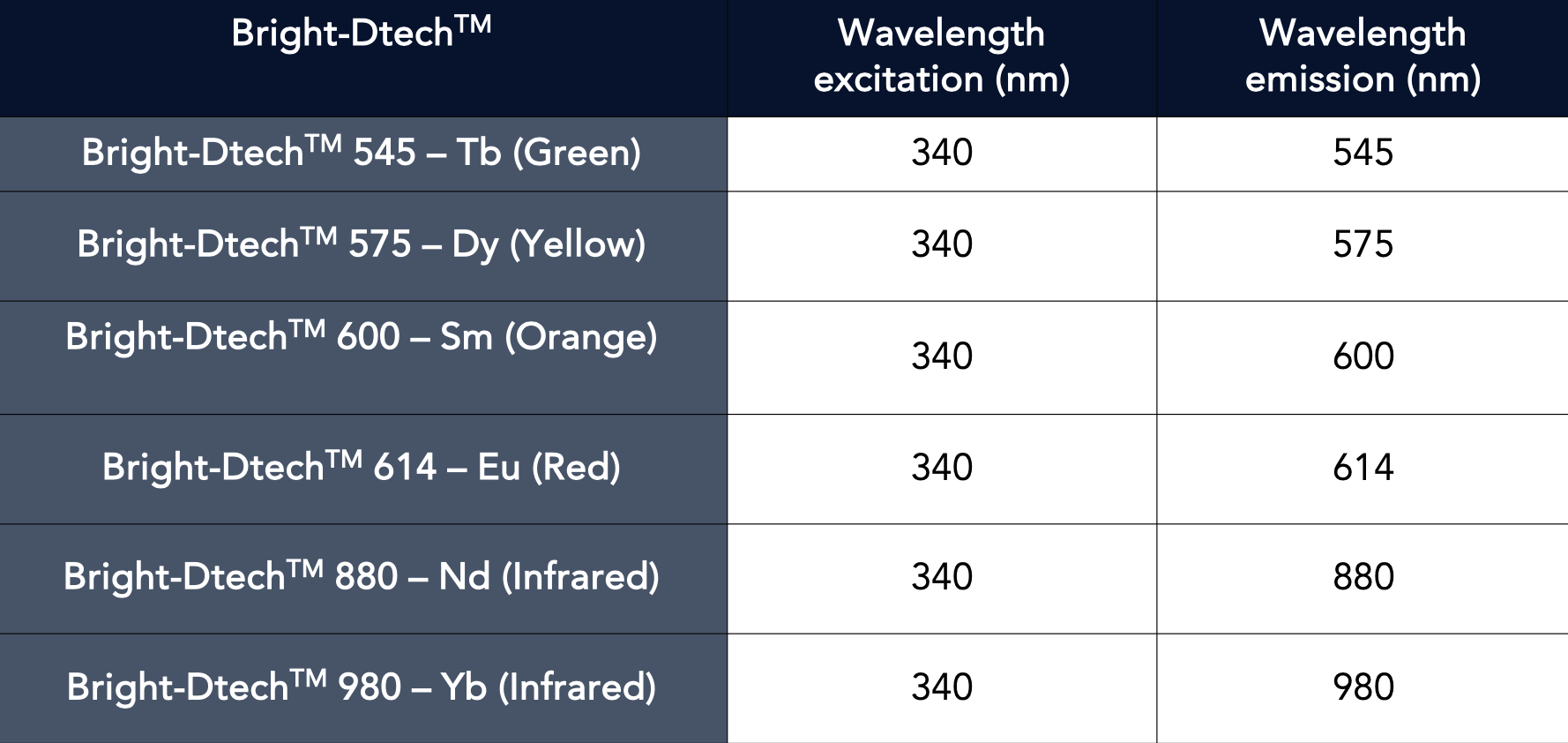
For more wavelengths, please contact us
How to store Bright-DtechTM ?
Bright-DtechTM and all the components must be stored at 4°C
What is the shelf life of Bright-DtechTM?
The shelf life of conjugated nanoparticles is mourned 6-12 months.
In case of problems or questions, is there a technical support?
Yes, you can contact us. Our experts will help you to solve your questions or problems.
Link-Dtech™ Coupling kits
What can be coupled with Link-DtechTM?
Link-DtechTM allows the conjugation of antibodies, proteins or any other biological entities.
What is the specificity of the coupling?
Link-DtechTM is designed to couple antibodies and other biologicals. If you need a specific coupling (COOH, NH2, N3…), contact us.
How to couple Bright-DtechTM with Link-DtechTM?
Link-DtechTM allows to conjugate biological entities with Bright-DtechTM without complex coupling chemistry or having access to specialized chemistry capabilities or specific equipments.

Youtube video: https://youtu.be/21HC5tL9Mv4
What is included in the when choosing Link-DtechTM ?
Link-DtechTM kits include the nanoparticles, the dilution buffer and the coupling buffer.
How many antibodies can we couple with Link-DtechTM ?
With Link-DtechTM, it is possible to couple between 10 and 200 antibodies per nanoparticles.
How many tests can we do with Link-DtechTM ?
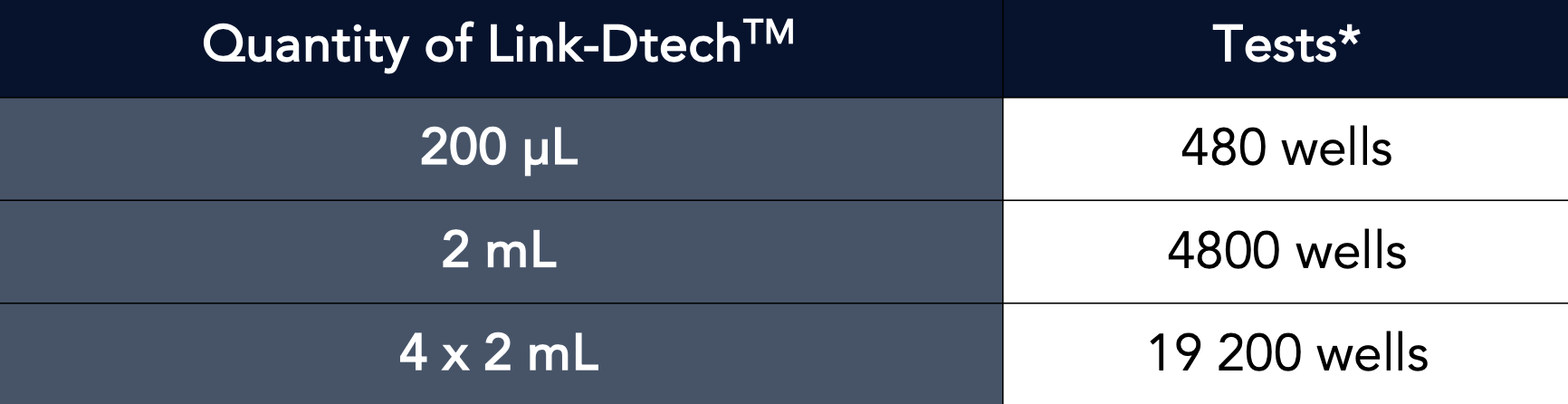
What is the yield with Link-DtechTM ?
The yield is more than 90%. And the number of antibodies around the nanoparticle can be checked by TR-FRET.
Can we use PBS with Link-DtechTM ?
It is strongly recommended not to use PBS Buffer with Link-DtechTM .
How can we verify that the antibody is correctly linked?
There are many validation steps:
- To check that there is no loss of nanoparticles, it is possible to check with the UV lamp
- If Link-DtechTM is coupled with an antibody, it is possible to verify with lateral flow strips or FLISA. If the conjugation was made with other biological samples, contact us.
How to store Link-DtechTM ?
Link-DtechTM and all the components must be stored at 4°C.
What is the shelf life of Link-DtechTM ?
The shelf life of Link-DtechTM is 1 year.
NoW-Dtech™ TR-FRET kits
What is TR-FRET detection method?
Time-resolved fluorescence energy transfer (TR-FRET) represents the practical fusion of Time-Resolved Fluorescence (TRF) with Förster Resonance Energy Transfer (FRET) offering a powerful tool researchers in drug discovery. TR-FRET combines the low-background nature of TRF with the homogeneous assay format of FRET. The combined assay offers increased flexibility, reliability and sensitivity along with higher throughput and a reduced occurence of false-positive and false-negative results. FRET involves two fluorophores, a donor and an acceptor. When the donor is excited by an energy source (such as flash lamp or laser), it transfers energy to the acceptor if they are within a specific proximity to each other. Subsequently, the acceptor emits light at its characteristic wavelength.

Why using Bright-DtechTM for TR-FRET?
Bright-Dtech™ technology brings a more sensitive and stable approach due to an improved limit of detection thanks to the brightness, a high photostability and a long emission lifetime.
How to use NoW-DtechTM ?
For an optimal use of NoW-DtechTM, please follow the whole data sheet of the assay kit.
For all technical support or further information, please contact us.
What are the kit components of NoW-DtechTM ?
NoW-DtechTM includes Standard Stock, Bright-Dtech™ Donor antibody, Acceptor antibody, TRF Buffer and a 96-well black microplate.
What are the advtanges of TR-FRET compared to ELISA?
- Increased Sensitivity: Thanks to the energy resonance between two fluorophores, the FRET method can detect molecular interactions, enabling more accurate detection of biomarkers, even in samples with low concentrations.
- Dynamic Response: Unlike ELISA, the FRET method provides a real-time dynamic response. This capability to monitor interactions in real time yields valuable data on molecular interactions, leading to a better understand of binding mechanisms and biological processes.
- Lower Cost: TR-FRET requires fewer reagents, consumables and a smaller sample volume, thereby reducing collection and storage costs
- Time-Saving: The FRET technique is faster than the ELISA one, simplifying the process by eliminating certain complex antibody-related steps.
- No Washing Steps: Additionally, it does not require washing steps. This speed allows for the execution of more experiments within a given timeframe.
NoW-DtechTM troubleshooting guide

FLISA-Dtech™ TR-FLISA kits
What is TR-FLISA detection method?
Fluorescence-Linked Immunosorbent Assay (FLISA) is an analytical method which can be used for the detection and quantification of specific proteins, biomolecules, peptides, cytokines, hormones, antibodies and more present in serum, plasma and cell culture supernatant. As TR-FRET, this method is based on Time-Resolved Fluorescence (TRF) and is a variant of the ELISA technique, replacing the enzymatic reaction with a fluorescence signal.
In Bright-Dtech™ FLISA method, detection/secondary antibodies are conjugated to fluorescent nanoparticles, the fluorescent intensity is measured by exposing the plate to light at a specific wavelength using time-resolved fluorescence reader, thereby enhancing the sensitivity of the analysis.
There are two common types of FLISA, namely Direct/Indirect FLISA and Sandwich FLISA. In Indirect FLISA, a Bright-Dtech-conjugated secondary antibody against the host species of the primary antibody is used for detection. In Direct FLISA, antibodies are directly conjugated to Bright-Dtech nanoparticles. In Sandwich FLISA, the detection antibody is linked to the Bright-Dtech™ fluorescent nanoparticles, enabling accurate and specific analyte quantification with minimal background noise. This final step can be performed using either direct or indirect methods (requiring a third antibody) for sandwich detection.

How to use FLISA-DtechTM ?
For an optimal use of FLISA-DtechTM, please follow the whole data sheet of the assay kit.
For all technical support or further information, please contact us.
What are the kit components of FLISA-DtechTM ?
FLISA-DtechTM includes Standard Stock, BDT Detection Antibody (200X), Wash Buffer (10X), Dilution Buffer, Assay Buffer and a 96-well black microplate (12 strips of 8 wells).
What are the advtanges of TR-FLISA compared to ELISA?
- Fast: Fluorescent reactions can be detected within minutes, in contrast to the longer time required by ELISA. This technique eliminates the need for enzymatic revelation.
- Enhanced Sensitivity: Fluorescence can detect lower concentrations compared to the ELISA method, thanks to more efficient fluorescent makers such as lanthanide nanoparticles
- Expanded Dynamic Range: The FLISA method can measure a broader range of concentrations without the need for frequent dilutions.
- Reduced Sample and Reagent Usage: FLISA often requires smaller sample volumes compared to ELISA. Additionally, it consumes fewer reagents, leading to cost and chemical consumption reduction.
- No Enzymatic Revelation Required: The FLISA method eliminates the need for enzymatic revelation, saving time and preventing cross-reactions between samples and enzymes.
FLISA-DtechTM troubleshooting guide

Custom Assay Development
Which kind of services are offered?
We provide three types of services:
- Development, Validation and Manufacturing of a ready-to-use kits
- Enhancement of your test or conversion of your ELISA test into a TR-FRET or TR-FLISA assay
- Development of Nanoparticles in various sizes
What are the steps of the assay development?
1.Preliminary Research: The initial step in the development involves defining the project specifications and the most suitable strategy. This includes determining the test type, the target to be quantified, the expected amount of antigen, the matrix, and the choice of primary materials.
2.Optimization: Subsequently, we focus on studying precise and optimal performance conditions at each step of the test protocol. During this phase, we assess and optimize various parameters and conditions such as the selection of the best acceptor, saturation, antigen capture, detection, incubation time and temperature, among others.
3.Validation: The validation phase is essential to ensure that the method provides consistent, reliable, robust, and accurate results. The validation of the analytical method involves conducting the following experimental checks:
- Specificity
- Linearity (range, LLOQ)
- Sensitivity (LOD)
- Accuracy (spking recovery test)
- Precision (repeatability and reproducibility)
- Robustness
Is Poly-Dtech CIR approved?
Yes, since 2023, Poly-Dtech is CIR (Crédit Impôt Recherche) approved, allowing a 30% tax reduction for companies utilizing our R&D services (antibody conjugation and custom assay development) for the next three years.
About Poly-Dtech
What is Poly-Dtech and its mission?
Poly-Dtech is a French company, based in Strasbourg, specializing in the field of life sciences and in vitro diagnostics (IVD). We specialize in the development and production of high-performance fluorescent nanoparticles and immunoassays, each with unique characteristics designed to enhance the detection of biomarkers for scientific research. Our products offer superior detection sensitivity through user-friendly protocols applicable in bioanalytical methods (immunoassays) and various molecular and cellular biology techniques.
Poly-Dtech’s technology is the culmination of many years of work and collaboration among experts in nanoparticle synthesis, spectroscopy, biology and analysis techniques, both in France and around the world.
Through our technology, our aim is to advance current screening, drug discovery and early disease diagnosis, ultimately improving the quality of life for patients and expanding treatment options.
Who are we?
Poly-Dtech’s team are experts in chemistry and biology between France and Hong-Kong. This multi-disciplinary approach, coupled with a multicultural background, not only provides the required skills and experiences, but also encompasses a diverse set of values, beliefs and perspectives. This diversity fosters a unique environment for innovation.
How to place an order on the Poly-Dtech website?
Poly-Dtech’s website has an e-commerce shop. Thus, you can place an order of Bright-DtechTM, Link-DtechTM, NoW-Dtech or FLISA-Dtech here.
What are the delivery times for the kits?
Our kits can be sent within 5 working days all around the world.