
Multiplexing
Multiplexing enables the simultaneous detection of multiple biomarkers in a single assay. By combining distinct fluorescent acceptors with suitable detection methods, multiplexing increases throughput and improves assay efficiency. Our multiplexing technology is based on TR-FRET, a rapid, no-wash, and low-interference technique.

TR-FRET immunoassays enable the detection and quantification of biomarkers in samples such as serum, plasma, and cell supernatants. Bright-Dtech™ fluorescent lanthanide nanoparticles provide bright and stable donor signal, supporting sensitive detection and excellent signal-to-background performance. By combining Bright-Dtech™ donor nanoparticles with target-specific acceptors, our technology enables the simultaneous detection of multiple biomarkers.
In Bright-Dtech™-based TR-FRET multiplex assays, each biomarker is detected using a specific recognition reagent and a corresponding fluoresecnt acceptor.
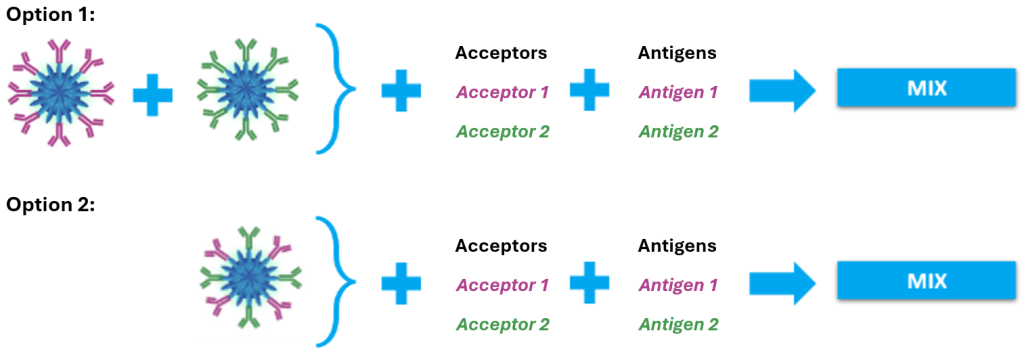
Upon excitation, energy is transferred from the nanoparticle donor to the acceptor when they are in close proximity. The resulting acceptor signals are measured using a time-resolved fluorescence (TRF) microplate reader. By distinguishing the signals associated with each target, individual standard curves can be established to quantify the biomarkers of interest.


Why choose Bright-Dtech™ for multiplexing ?
Bright-Dtech™ technology supports sensitive ans specific biomarker detection, with the potential to improve limits of detection (LOD) and limits of quantification (LOQ). The high-signal intensity and long fluorescence lifetime of our lanthanide nanoparticles help reduce background interference and improve signal-to-background performance.
Bright-Dtech™-based TR-FRET assays can also help reduce assay complexity and costs through rapid, no-wash workflows using a microplate reader equipped with a TRF option.